
日本語 | English
YAMAGATA UNIVERSITY · JAXA SPACE STRATEGY FUND
STAR-MEALS
Space Gastronomy
Eating well, in space and on Earth.
Innovative Space Gastronomy Technology Development Hub
Connecting long-term food preservation, 3D/4D food printing and digitally supported dining.
Led by Yamagata University, STAR-MEALS explores technologies and systems that support the pleasure of eating in space. It is a selected research project within SX-CRANE, a technology development theme under the JAXA Space Strategy Fund.
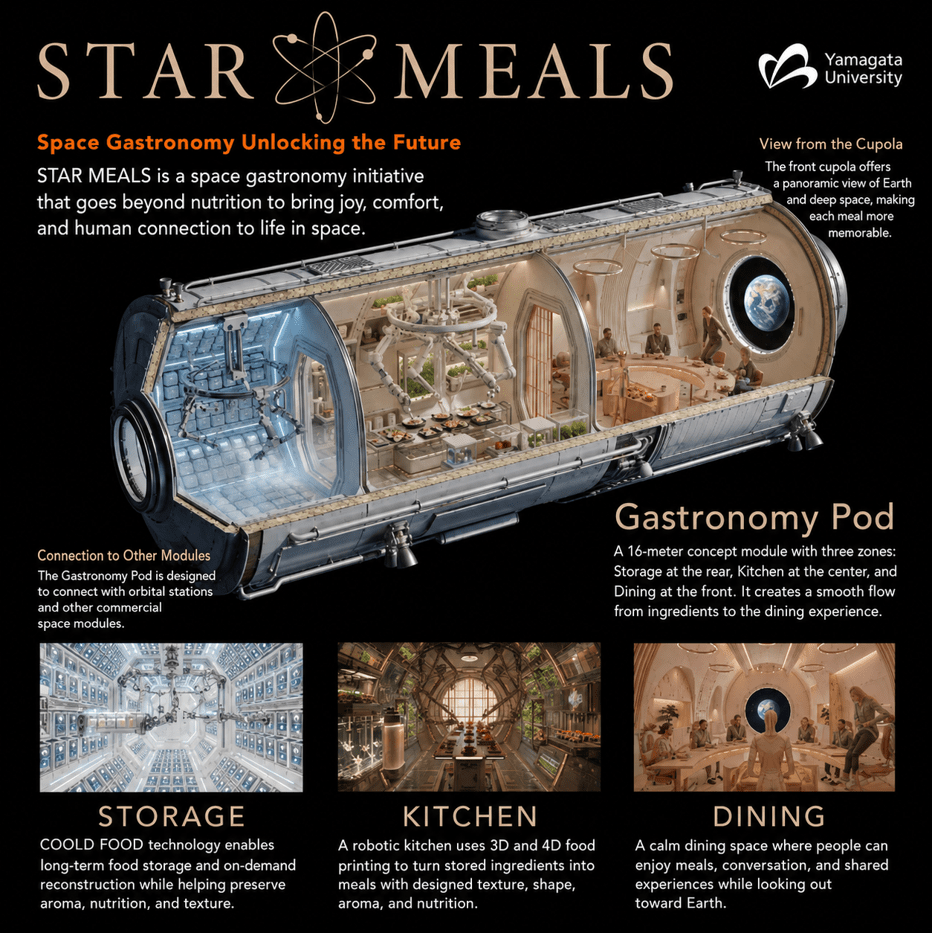
Food as a foundation for a richer life.
During long-duration space missions, meals can support health, comfort, conversation and cultural connection. STAR-MEALS considers both physical and mental well-being in the design of future dining experiences.
We connect food preservation, reconstruction, preparation, serving and evaluation to explore how people can eat well in closed environments.
Our research|From preservation to dining
01 | Preserve food
We study long-term food preservation using frozen gel-based materials and powdered ingredients. COOLD FOOD uses cryogenic milling to turn frozen foods into powders, connecting preserved ingredients with food printing and preparation. Making food available when needed is a starting point for supporting extended missions.
02 | Reconstruct food
We explore 3D/4D food printing to turn ingredients into edible forms. Digital designs guide the creation of shapes and textures, while our research into 4D edible materials explores changes in response to temperature and other stimuli. We consider texture, aroma and nutrition together with the satisfaction of the person eating.
03 | Connect preparation and experience
We investigate food preparation, serving and dining evaluation using robotics and digital technologies. Our Digital Restaurant System (DRS) aims to connect the conversation and presentation provided by an avatar chef with the preparation and serving performed by cooking robots. The goal is to design cooking and the enjoyment of a meal as one connected experience.
Using AI for texture analysis and methods for evaluating dining experiences, we explore meals suited to individual preferences and eating needs. This brings preservation and food printing technologies together in systems for preparing and enjoying meals.
A future concept integrating the three research pillars
The Gastronomy Pod brings food preservation, reconstruction and preparation together with a place to enjoy meals. By connecting the three research pillars and considering resource circulation, we envision a system that supports food and dining in a closed environment.
This is a future concept, not an operational unit. Visit the STAR-MEALS project website to explore concept visuals of the Gastronomy Pod and ground demonstration facilities.
From space to Earth
Research under space constraints can also inform food systems on Earth. Starting with the person eating, we consider ingredients, texture, appearance and the dining environment together, and evaluate their value for users.
| Potential application | Value we aim to create |
|---|---|
| Nursing care foods | Combine textures that are easier to eat with an appealing, recognizable presentation, supporting the pleasure of eating and choosing meals. |
| Disaster preparedness | Consider both preservation and meal satisfaction, exploring preparation and serving under limited conditions and applications for emergency food supplies. |
| Regional food industries | Connect local and underused ingredients with new processing and serving methods, developing products and services that reflect regional food cultures. |
| Restaurants and food services | Explore dining experiences that combine texture and shape design with digital presentation, tailored to individual preferences and eating needs. |
Toward a space restaurant in 2040
We aim to realize a space restaurant in 2040, progressing from demonstrations on Earth toward dining in space.
| Time frame | Stage and planned activities |
|---|---|
| 2026–2029 | Ground demonstrations: evaluate ingredients, equipment and dining experiences through the Tengendai Alpine Lab concept and urban demonstration sites. |
| 2030–2033 | Integrated validation: bring together food preservation, 3D/4D food printing and DRS, and examine practical operating conditions. |
| 2040 (target) | Space restaurant: aim to create a place to enjoy meals in space through a Gastronomy Pod envisioned for connection to a future space station. |
The facilities and Gastronomy Pod are future concepts. Space deployment requires validation for the space environment. The research project’s planned implementation period is April 2026–March 2034; 2040 is a longer-term realization target beyond that period.
Project information
| Project | Innovative Space Gastronomy Technology Development Hub (STAR-MEALS) |
| Program / Theme | JAXA Space Strategy Fund / SX-CRANE SX-Center of Research ANd Engineering |
| Lead institution | Yamagata University, Japan |
| Research lead | Hidemitsu Furukawa |
| Planned implementation period | April 2026–March 2034 |
Collaborating organizations
Kyushu University / The Ritsumeikan Trust / Yamagata Research Institute of Technology / Ichimasa Kamaboko Co., Ltd. / Watami Farm Co., Ltd. / Fuji Oil Co., Ltd. / F-EAT Inc.
The organizations listed above are the planned collaborators named in JAXA’s selection announcement.
The linked selection announcement and program page are in Japanese. This project introduction is maintained by SWEL Lab, Yamagata University.
Related research
SWEL Lab also conducts Moonshot research on long-term food preservation and SIP3 / GASTROVERSE research on dining experiences. These are separate projects with their own program objectives, contributing to our broader exploration of future food.
Shaping the future of food with industry
From ingredients and equipment to spaces and services, we explore opportunities for joint research and demonstrations, starting with your technology and the food-related challenges you want to address.
| Field | Examples of collaboration topics |
|---|---|
| Food, materials and packaging | Food preservation, powdered ingredients, texture, aroma and packaging. We consider food quality and suitability for printing. |
| Machinery, robotics and measurement | Automated food printing and preparation, quality measurement and evaluation. We explore equipment and workflows suited to the setting in which meals are served. |
| Food services, care and regional communities | Evaluate menus, serving methods and user responses, bringing feedback from diners and practitioners into development. |
| Architecture, environment and digital technology | Explore dining spaces, resource circulation and remote shared meals as part of systems that support food and everyday life. |
An initial discussion helps us understand your challenges and technologies, define a research topic and consider how to proceed with research or demonstrations. Please tell us about your technology and the food-related challenge you would like to address.
These are examples of potential collaboration topics. The scope and approach will be discussed individually.
Collaborate with us
For research and collaboration inquiries, please contact the SWEL Lab assistant.
SWEL Lab (Soft & Wet Matter Engineering Laboratory), Yamagata University
4-3-16 Jonan, Yonezawa, Yamagata 992-8510, Japan
Email: swel@gp.yz.yamagata-u.ac.jp

